
APPLICATION OF RFID TECHNOLOGY ON COLLEGE STUDENTS ATTENDANCE AND LIBRARY SECURITY SYSTEM
Dr.D.Sathish Kumar
Asst.Professor, SIMS
RFID is known as Radio-Frequency IDentification. The RFID refers to small electronic devices that consist of a small chip and an antenna. Normally the chip carries 2000 bytes of data or less. The RFID device scans the bar code or a magnetic strip on the back of any card to get the information, the RFID device must be scanned to retrieve the identifying information. In this article explains the application of RFID technology in college student attendance system and library security system. To improve the education level of the institution RFID system implementation plays a important role in the work of management of college students learning efficiency, also improving grade of the student and making the college assets like library system to keep secure. Therefore, colleges need an information system platform of check attendance management and library security information’s using the information technology which gathers the basic information of student automatically. Library consists of journals, books, reports, thesis etc. For security purpose, the goal of the security system should be to provide a safe and secure facility for library resources and equipment.
STRUCTURE OF RFID SYSTEM
Development of Science and Technology there is multiplicity of student’s attendance systems. Though the products and technology of the subsist attendance systems have been comparatively grown-up, but more often than not used in housing, office buildings etc. Particularly, these attendance system are frequently used contactless classification or biometric technology, it is hard to meet the distinctiveness about large number of persons and the burly liquidity. To solve the problem, combine with the unambiguous situation of the college or university classroom, the attendance system swelling of student classroom based on RFID has been intended.
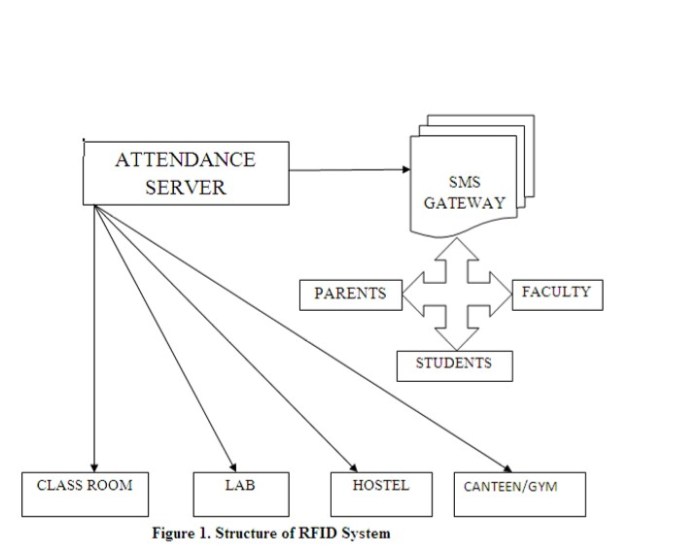
From the Figure.1 Structure of RFID system it shows the attendance server is connected with Class Room, Lab, and Hostel also in Canteen/Gym. The presence of the students will be recorded in the attendance server. The absence of the student details will be stored and the information is passed to students, parents and faculty through SMS.
TYPES AND SELECTION OF RFID TAGS
RFID tags can be divided in to different types.
• Read-Write tag
• Active and Passive tag
• Initiative tag
• Low, High or Ultra Frequency tag
Read-Write tag data read and write type, tag can be divided into read-only tag and read-write tag. Similarly for Active and Passive tag, the power supply, tag can be divided into active tag and passive tag. For Initiative tag is like modulation schemes, tag can be divided into initiative tag and passive tag. Low, High or Ultra Frequency tag, the work frequency, tag can be divided into low frequency, high frequency, ultrahigh frequency. Low frequency tag’s work frequency range is 30 to 300 KHz, classical frequency is 125KHz and 133KHz, the readable distance is 10cm. High frequency tag’s work frequency range is 3 to 30MHz, classical frequency is 13.56MHz, the readable distance is 1m.Ultrahigh frequency tag’s work frequency is 300Mhz to 3Ghz, the classical frequency is 433Mhz, 902 to 928 MHz, 2.45 GHz and 5.8GHz. To determine the type of RFID tag, the width of the doors of the class rooms.
RFID LIBRARY SECURITY SYSTEM
APPLICATION OF RFID TECHNOLOGY ON COLLEGE STUDENTS ATTENDANCE AND LIBRARY SECURITY SYSTEMu
RFID in library security system will reduce the time of library staffs by making the system to make automatic their errands. RFID library management helps to an establishment that uses by saving the book readers time by searching, borrowing or returning a book. Taking care of books and making them accessible to the book readers are significant errands. Library staffs spend time mainly in recording information of inward and extrovert books. Borrowing and returning of books can be recorded automatically with the help of self check-in and check-out systems. This system engages installation of particular software. An individual using this software to borrow books is obtainable with options on a computer monitor. The individual has to recognize himself with a code, which is preferably a individual identification number, or an unique identity code. Books selected by the individual are recognized by the systems integral RFID reader, and the observation fragment in the books tag is disabling by the system. When a book is returned, the check-in and check-out system triggers the observation fragment.
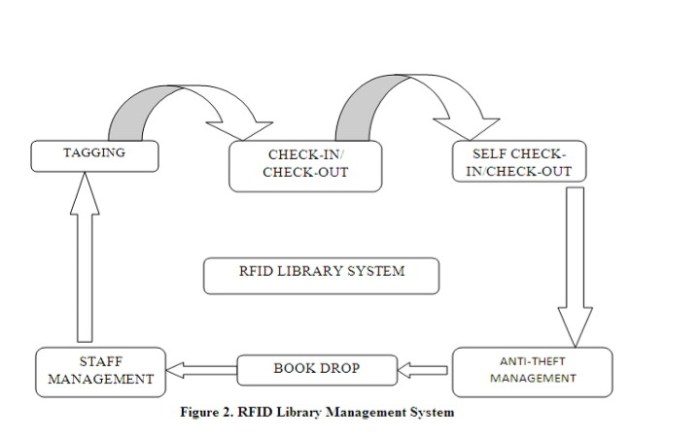
Figure 2 shows the RFID library management system operation, the operations are
Tagging: The most significant link in any RFID system is Tagging. It has the capability to accumulate information involving to the exact item to which they are attached, redraft over without any constraint for contact or line of sight. Data within a tag may afford classification for an item, evidence of possession, unique storage place, status and history. RFID tags have been purposely premeditated to be attached into library media, include books, CD’s and DVD’s ‘.
Self Check-in/Check-Out Station: The system is developed with a special software connected with a touch screen computer with built in RFID reader to identify the personal data, book and other library services. After identification of the library ID card like bar code or personal identification number the software in the system will instruct to choose for the next option like check-in or check-out of several books. By selecting the options the books availability is recorded automatically.
Anti-theft Management: RFID is the anti-theft part of the Library RFID Management System using the same RFID tags entrenched in the library items. Each path is able to follow substance of about 2 meter and would activate the alarm system when an un-borrowed item passed through them. The alarm will sound and lights on the gate will flash as patron passes through with the un-borrowed library material.
Book Drops: The RFID book drop is usually located outside of the library premises. It allows books, CDs and other library materials to be returned safely and securely any time and even before or after library working hours. The RFID book drop creates another easy return option for library patrons as library materials can be returned 24 hours a day any time convenient to the patrons. The use of RFID book drop will increase customer service because library staff will have more time to assist library patrons. Overall, queuing and waiting time for book return will be reduced significantly.
Staff management: It is a staff assisted services such as return, tagging, categorization and etc. It is encumbered with arming/disarming component, tagging component and categorization component. Arming/Disarming component allows Electronic Article Surveillance fragment inside the tag of the library objects to be set/reset so as to trigger/not trigger the alarm of the Electronic Article Surveillance gate.
 SANKARA BLOG
Wow excellent proposal pls implement in Sims.
LikeLike