How to profit from Mutual Funds

How to profit from Mutual Funds

– S.SARAVANAN, Assistant Professor, SIMS

If you want to go to Goa from Mumbai, there are several vehicular options. You can travel by airplane, drive in car, take a train or a bus, or sail in a ship. Similarly when we want to make any kind of investment, there are different investment vehicles, e.g. mutual fund, portfolio management services, “direct” (investing on your own), insurance, etc.

Goa is the destination and airplane, car, bus, train, ship, etc are vehicles. Similarly, debt, equity and property are asset classes, and mutual funds, PMS and insurance are investment vehicles.

It is important to clarify here that property includes real estate, bullion, collectibles, art, etc. To invest in debt, equity and property we have to choose investment vehicles, which suit our requirement.

In earlier times, “direct” was the only investment vehicle available. If we wanted to buy fixed deposit/bond we had to apply on our own. Similarly, when we wanted to buy shares, we had to call up stock brokers, who would procure shares on our behalf and same was the case with property.

The cost involved in “direct” buying is least amongst all investment vehicles. However, we need to have skills and time to use this form of investing. Another investment vehicle is a mutual fund. Mutual fund works on the concept of pooling in money. Assume there are 5 to 6 friends who want to invest money in a particular asset class say equity. Also assume they do not have skills and time.

However, one of them knows an expert who regularly invests in the stock markets. All these friends go to an expert and give him their investment amount. The expert invests on their behalf. If there is profit in investment, they all benefit and if there is any loss, they suffer.

Experts get certain fee for investing on their behalf. This is the concept of a mutual fund. Investing in a mutual fund is slightly expensive than “direct” form of investing. However, the decision-making and procedure of investing is transferred to the mutual fund company.

Insurance, as an investment vehicle, works somewhat similar to mutual fund as far as ULIPs (Unit-Linked Insurance Policies) are concerned. While traditional insurance plans invest only in debt-based products and are not market linked, ULIP invests in debt, equity as well as a combination of the two.

The only difference in the case of insurance is that expenses charged by the insurance company are much higher that most other investment vehicles.

PMS is usually tailor-made for your needs. Based on your financial goals, portfolio managers create an investment portfolio for you. For creating and maintaining your portfolio, the manager charges fees. Also if your portfolio earns profit beyond a certain amount, then the portfolio manager shares the profit. However, if there are losses then the same is charged to your account only.

While choosing any investment vehicle keep in mind your skills, time available with you to create and maintain your investments and costs involved.

If you have the skills and time available with you then “direct” form of investing is ideal as it has least of costs amongst all other vehicles.
On the other hand, insurance is the most expensive investment vehicle and hence it should be kept away from as far as possible.

PMS works better for wealthy (high net worth) individuals. Although profits have to be shared, there is also the advantage of getting tailor-made portfolio. Only catch is to ensure that portfolio created and maintained for you is tailor-made and that the PMS is not another mutual fund scheme, where all investors get the same portfolio.

For small and medium investor who does not have the skills or the time mutual funds seem the best option.

Currently, in India, we have mutual funds which invest in two asset classes, debt and equity. However, in the very near future there is a likelihood of having mutual funds, which will invest in gold as well as real estate.
THIS STARTUP WANTS TO BE FLIPKART OF LOGISTICS

THIS STARTUP WANTS TO BE FLIPKART OF LOGISTICS 

Dr.D.Sathishkumar, Assistant Professor, Sankara Institute of Management Science(SIMS)

        Logistics

         The online logistics and freight management industry has seen a raft of entrants over the past 3-4 years as players try to streamline inter-city and intra-city logistics management in India. Taking a cue from BlackBuck and the Rivigo, a new kid on the block, Cogoport, has its eyes set on international waters

          Founded in May 2016, Cogoport is an online logistics marketplace that aggregates ocean and airline freight carriers for exporters and importers across a host of categories. Cogoport offers price comparisons across players, where asset owners such as Maersk, Mediterranean Shipping Company and others, can bid for a freight order in case of high demand.

The company also offers door-to-door services by way of price comparisons for trucking, custom charges and inland docking charges from the same platform.
With an average volume of 500 containers shipped through the portal each month, Cogoport follows a commission-based model of monetization with an average commission of 6-7% per order.

“The bulk of shipment volumes come from perishables, textiles, ceramic and tiles. Our target is to reach 1,000 containers of shipments per month by August,” Kumar said. Cogoport currently operates out of Gujarat and Mumbai ports.
The founding team has an extensive experience in the international freight business through previous stints at Maersk and Damco among others, which has helped the company raise its first round of funding of $950,000 from a Singapore-based high networth individual (HNI) in December.

Currently, Cogoport clocks monthly revenues of Rs 3.15 crore and is looking to expand into newer business lines as it targets a 6x growth in FY18 with a monthly revenue run rate of Rs 19 crore ($3 million)

          The company expects to bring down the size of its ocean freight business, which currently forms almost 95% of its revenue share, to 60% as it looks to strengthen its play in airline freight services, trucking, insurance and the high-margin custom services.

“As a high-margin category, we expect the customs business to aid our gross margins and take it to 10% from the current 6%,” Kumar said.

Globally, the freight forwarding industry is a multi-trillion dollar one with no Indian company commanding the scale and depth of the top players in the field.

Cogoport is looking to become India’s answer to global giants in the space including Flexport, Freightos and Xeneta.


BRICS nation’s sign Taxation Cooperation Memorandum

BRICS nation’s sign Taxation Cooperation Memorandum

Dr. Priya Kalyanasundaram | Head of Department

Sankara Institute of Management Science(SIMS)


Tax authorities of the BRICS- Brazil, Russia, India, China and South Africa have signed BRICS Taxation Cooperation Memorandum to establish a mechanism for taxation cooperation. The landmark document is the bloc’s first document that elevates taxation cooperation to the institutional level. It was signed at the fifth meeting of BRICS Heads of Tax Authorities. Key Facts The BRICS countries are home to 42% of the world’s population. Their total share in the global economy has risen from 12% to 23% in the past decade, while contributing more than half of global growth. The meeting of tax authorities comes ahead of the 2017 BRICS Summit to be held in Xiamen, Fujian province of China in September 2017. In this meeting, tax authorities from member countries also agreed to cooperate on taxation information exchange, boost taxation capacities, improve consultation procedures efficiency and plan paths for coordination of taxation policies and tax collection

BRICS countries-Brazil, Russia, India, China, South Africa have agreed to work together to ensure stable employment and better quality of life for their people. Decision in this regard was taken at the 2017 Labour and Employment Ministers’ meeting held in Chongqing, China. The meeting comes ahead of 2017 BRICS Summit to be held in Xiamen, China in September 2017. Key Highlights of meeting Labour and Employment Ministers from BRICS counters discussed topics ranging from skills-driven development to a universally sustainable social security system. They passed BRICS Labour and Employment Ministerial Declaration. It covers a variety of areas that are of critical importance to all BRICS countries including India and called upon strengthening collaboration and cooperation on these through appropriate institutionalization. These areas covered under the declaration consist of Governance in the Future of Work, Universal and sustainable social security systems, Skills for development in BRICS, BRICS Social Security Cooperation Framework, BRICS Network of Labour Research Institutions and BRICS entrepreneurship research. They also presented four documents, including one on common ground in labour market governance and an action plan on skills-driven poverty alleviation. They also held that they should work together to boost employment and inclusive growth, enhancing the skills of professionals to alleviate poverty. BIRCS BRICS is the acronym for an association of five major emerging national economies: Brazil, Russia, India, China and South Africa. The BRICS members are all developing or newly industrialized countries and all five are G-20 members. They are distinguished by their large, fast-growing economies and significant influence on regional and global affairs. It was established in 2009. The BRIC idea was first conceived by Jim O’Neill of Goldman Sachs. In 2011, South Africa joined this informal group and BRIC became BRICS. So far, eight BRICS summits have taken place. The first formal summit was held in Yekaterinburg, Russia in 2009.

“Impact of GST on Indian Economy”

Impact of GST on Indian Economy”

Dr.S.Sundararajan, Associate Professor, Sankara Institute of Management Science(SIMS)

Impact of GST on Indian Economy, Impact of GST in India. Amidst economic crisis across the globe, India has posed as a beacon of hope with ambitious growth targets, supported by slew of strategic missions like ‘Make in India’, ‘Digital India’, etc. Goods and Services Tax (GST) is expected to provide the much needed stimulant for economic growth in India by transforming the existing basis of indirect taxation towards free flow of goods and services within the economy and also eliminating the cascading effect of tax on tax. In view of the important role that India is expected to play in the world economy in the years to come, the expectation of GST being introduced is high not only within the country, but also in neighboring countries and in developed economies of the world.

GST Impact on India

(a) Increased FDI: The flow of Foreign Direct Investments may increase once GST is implemented as the present complicated/ multiple tax laws are one of the reasons foreign Companies are wary of coming to India in addition to widespread corruption.

(b) Growth in overall revenue: It is estimated that India could get revenue of Rs.1500 crores per annum by implementing the Goods and Services Tax as it would promote exports, raise employment and boost growth. Over a period, the dilution of the principles may see that only part of this is accruing.

(c) Single point taxation: Uniformity in tax laws will lead to single point taxation for supply of goods or services all over India. This increases the tax compliance and more assesses will come into tax net.

(d) Simplified tax laws: This reduces litigation and waste of time of the judiciary and the assessee due to frivolous proceedings at various levels of adjudication and appellate authorities. Present law appears to be much worse and an amalgam of the bad parts of VAT/ ST/ CE.

(e) Increase in exports and employment- GST could also result in increased employment, promotion of exports and consequently a significant boost to overall economic growth and factors of production -land labour and capital.

Impact of GST on Indian Economy

  • Reduce tax burden on producers and foster growth through more production. This double taxation prevents manufacturers from producing to their optimum capacity and retards growth. GST would take care of this problem by providing tax credit to the manufacturer.
  • Various tax barriers such as check posts and toll plazas lead to a lot of wastage for perishable items being transported, a loss that translated into major costs through higher need of buffer stocks and warehousing costs as well. A single taxation system could eliminate this roadblock for them.
  • A single taxation on producers would also translate into a lower final selling price for the consumer.
  • Also, there will be more transparency in the system as the customers would know exactly how much taxes they are being charged and on what base.
  • GST would add to government revenues by widening the tax base.
  • GST provides credits for the taxes paid by producers earlier in the goods/services chain. This would encourage these producers to buy raw material from different registered dealers and would bring in more and more vendors and suppliers under the purview of taxation.
  • GST also removes the custom duties applicable on exports. Our competitiveness in foreign markets would increase on account of lower cost of transaction.
  • The proposed GST regime, which will subsume most central and state-level taxes, is expected to have a single unified list of concessions/exemptions as against the current mammoth exemptions and concessions available across goods and services

The introduction of Goods and Services Tax would be a very noteworthy step in the field of indirect tax reforms in India. By amalgamating a large number of Central and State taxes into a single tax, it would alleviate cascading or double taxation in a major way and pave the way for a common national market. From the consumer point of view, the biggest advantage would be in terms of reduction in the overall tax burden on goods and services. Introduction of GST would also make Indian products competitive in the domestic and international markets. Last but not the least, this tax, because of its transparent character, would be easier to administer. However, once implemented, the system holds great promise in terms of sustaining growth for the Indian economy.

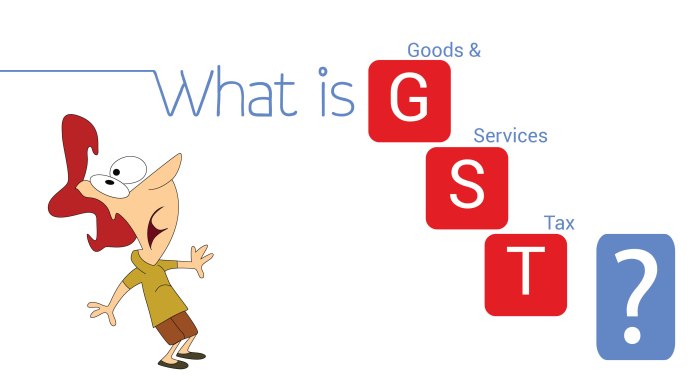
GST

GST

-Mrs. Nishanthi.S

Assistant Professor

What-is-GST-01

GST is a transformational tax reform in our country since independence. It is an indirect tax that is imposed on goods as well as services. GST is particularly designed to replace the indirect taxes levied on goods and services by the Centre and States. GST can be termed as “One Tax, One Nation and One Market”. GST is a highly compliance driven law.GST is one indirect tax for the whole nation, which willmake India one unified common market.GST is a single tax on the supply of goods and services, right from the manufacturer to the consumer. Under this system, a single product will be taxed at the same rate in every corner of the country and so honorable Prime MinisterNarendra Modi hailed it as a “GREAT STEP BY TEAM INDIA” that will help transform the economy, bring in TRANSPARENCY and bring in the system of “ONE COUNTRY ONE TAX”.But still it does not mean that every item will be charged at the same price. Evidentlythe daily essentialwill be charged  at a lower rate than the luxuries, but a single luxury product or an individual necessity good will be charged the same rate throughout the country.More than 160 countries have already introduced GST/ National Level VAT.Canada and Brazil only have dual GST.


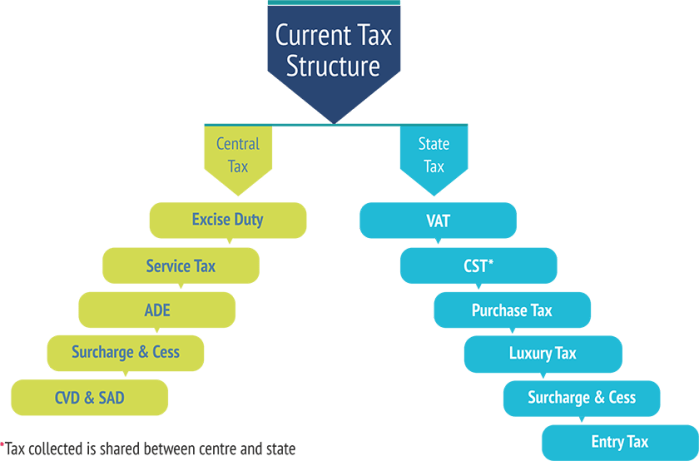
CURRENT TAX SYSTEM AND PROPOSED TAX SYSTEM:

CURRENT INDIRECT TAX STRUCTUREPROPOSED DUAL GST MODEL


Current GSTProposed GST


The following items will be replaced by GST which is currently imposed by Centre:-

  • Central Excise duty
  • Duties of Excise (Medicinal and Toilet Preparations)
  • Additional Duties of Excise (Goods of Special Importance)
  • Additional Duties of Excise (Textiles and Textile Products)
  • Additional Duties of Customs (commonly known as CAD)
  • Special Additional Duty of Customs (SAD)
  • Service Tax, Central cess and surcharge


The following items will be replaced by GST which is currently imposed by State:-


  • State VAT
  • Central Sales Tax
  • Luxury Tax
  • Entry Tax (other than those in lieu of Octroi)
  • Entertainment Tax (not levied by the local bodies)
  • Taxes on advertisements
  • Taxes on lotteries, betting and gambling
  • State cess and surcharges, as they relate to supply of goods or services
  • Stamp Duty & Registration Fees

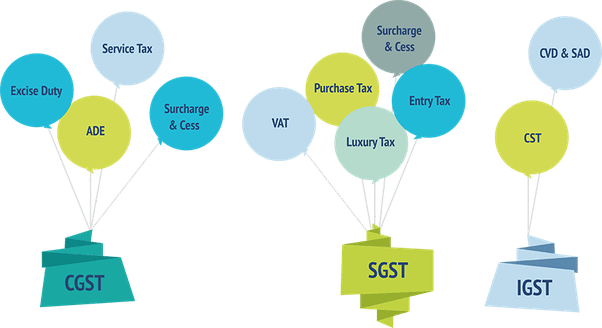
The proposed tax system will take the form of “dual GST” which is concurrently levied by central and state government. This will comprise of:

  • Central GST (CGST) which will be levied by Centre
  • State GST (SGST) Which will be levied by State
  • Integrated GST (IGST) – which will be levied by Central Government on inter-State supply of goods and services.

GST IMPLICATIONS

Under the current, non GST regime the indirect tax rate on goods is 27%-32% and on services its 15%. Under the proposed GST regime the expected GST rate would be 18%-22% where the cost of goods will go down and the cost of services will rise. The products like Groceries, Two-Wheelers, Small Cars, SUV, Consumer Electronics, Movie Tickets etc., will get cheaper and products like Air-Ticket, Mobile Phone, Insurance Premium, Eating-Out etc., will get costlier.Among all Petroleum products, Entertainment and amusement tax levied and collected by panchayat /municipality/district council, Tax on alcohol/liquor consumption, Stamp duty, customs duty,Tax on consumption and sale of electricity are exempted.

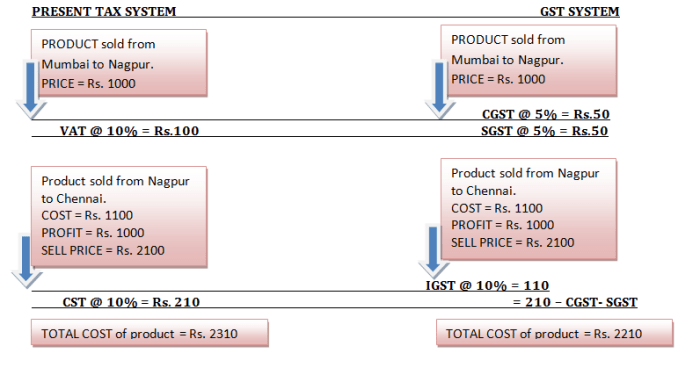
Example for GST

CONCLUSION

To conclude it is very encouraging that the GST bills are finally passed and on its way to become to make a nation proud. Therudimentary planning behind introducing GST is to convert India into a single market. This might have a positive impact on GDP of India and help to boost the Indian economy. One of the biggest taxation reforms in India – the Goods and Service Tax (GST) — is all set to integrate State economies and boost overall growth through a lower tax rate by increasing the tax.

Generic drug

Generic drug

K.Thirugnana Sambanthan |Assistant Professor

Sankara Institute of Management Science(SIMS)

generic-drugs-in-india

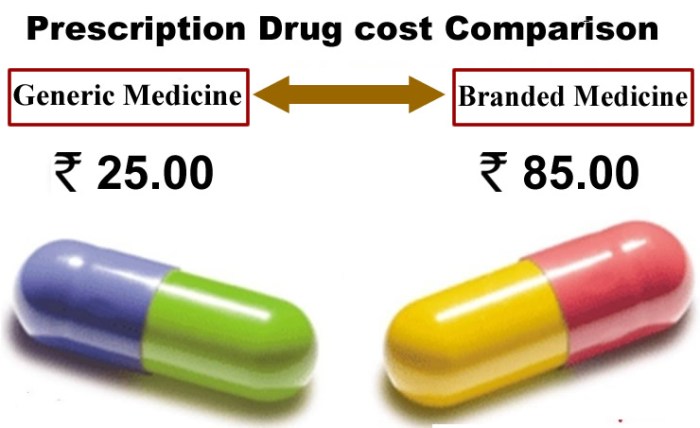
        In the present era, many people are infected with new diseases.  The cost of the drugs are becoming high for several dreadful diseases.  The common man is finding it difficult to buy these life saving drugs. The cost of  a cancer drug is around Rs.1.5 Lakhs, where as the same equivalent drug from another company is just Rs.8,500.  Most of the patients are buying the prescribed drugs in the recommended shop by the doctor. Pharmaceutical firms spend huge amounts in creating these brands. However, since prescription-based medicines cannot be promoted through advertisements, companies often push these brands through doctors and chemists. Consumers, who are often unable to make an informed choice for purchasing medicines, have to rely on the doctor’s prescription or on chemists.

A generic drug is a pharmaceutical drug that is equivalent to a brand-name product in dosage, strength, route of administration, quality, performance, and intended use.  The term may also refer to any drug marketed under its chemical name without advertising, or to the chemical makeup of a drug rather than the brand name under which the drug is sold.

Although they may not be associated with a particular company, generic drugs are usually subject to government regulations in the countries where they are dispensed. They are labeled with the name of the manufacturer and a generic nonproprietary name such as the United States Adopted Name or international nonproprietary name of the drug. A generic drug must contain the same active ingredients as the original brand-name formulation. The U.S. Food and Drug Administration (FDA) requires that generics be identical to, or within an acceptable bioequivalent range of, their brand-name counterparts with respect to pharmacokinetic and pharmacodynamic properties.

Generic_medicine_belgaum

Biopharmaceuticals such as monoclonal antibodies differ biologically from small molecule drugs. Generic versions of these drugs, known as biosimilars, are typically regulated under an extended set of rules.

The Indian government began encouraging more drug manufacturing by Indian companies in the early 1960s, and with the Patents Act in 1970. The Patents Act removed composition patents for foods and drugs, and though it kept process patents, these were shortened to a period of five to seven years. The resulting lack of patent protection created a niche in both the Indian and global markets that Indian companies filled by reverse-engineering new processes for manufacturing low-cost drugs. The code of ethics issued by the Medical Council of India in 2002 calls for physicians to prescribe drugs by their generic names only.

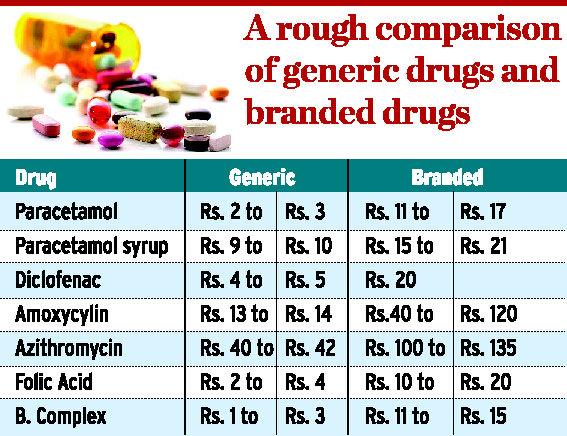
The  Indian government’s latest move providing an umbrella brand for generic drugs is aimed at enabling consumers to make that choice.  The consumer can walk to an chemist and ask for a ‘Jan Aushadhi’ brand for the prescribed medicine, with the government set to launch its own brand to sell low cost generic medicines.  This scheme is the cure for rising medicine prices.  A rough comparison of commonly used branded drugs and generic drugs is shown in the figure below.

Generic-Medicines-comparison

Any one who want to buy cheap medicine. Actually poor people are most benefited through Generic Medical Store. Prior that people don’t have choice to buy economical medicine. Now poor people and retired personnel can buy life saving drug through Generic Medical Store.

Helpline number for more information about Jan Aushadhi Generic Drug Store contact on this number 1800 180 80 80.

“LAL BATTI CULTURE”

“LAL BATTI CULTURE”

Dr. Priya Kalyanasundaram , Head of Department

Sankara Institute of Management Science(SIMS)

About six categories of beacons primarily red, blue and yellow are in use in India. But the red, or the coveted “lal batti”, has been drawing maximum attention as an elitist VIP symbol since the British rulers introduced it. People often saw these flashing lights as shining examples of power and VIP status, more than security aids. Status-conscious politicians and government officials are also accused of using the beacons to bypass the gridlocked city traffic on official business and show off their importance. Even lower-level politicians and officials misuse the beacons to show off their importance, especially in smaller towns.

As per our Prime Minister Narendra Modi “ Every Indian is special, every Indian is a VIP,” he has decided to shake up India’s privileged VIP culture, most notably symbolised by flashing red beacon lights on top of vehicles, by scrapping a rule that allowed the Central and State governments to nominate dignitaries who could use such lights. This decision was taken at a meeting of road transport officials with the prime minister’s office on April 15. The Prime Minister informed his cabinet about the move on Wednesday. “We have decided to remove the clause from the Central Motor Vehicles Rules, 1989, that gave the Centre and states the power to decide who should be allowed to display red beacons. Moreover, States are also being stripped of their power to specify persons whose vehicles can use blue flashing lights. From May 1st , only emergency services vehicles such as ambulances, fire engine trucks, and police vehicles will be allowed to use blue lights. Red lights will not be permitted on any vehicle. Private vehicles will not be allowed to use either red or blue lights.

In 2014, the Supreme Court said the use of beacons should be restricted and only constitutional authorities should be allowed to use it. “Red beacons and multi-toned horns are reflective of Raj mentality and are an antithesis of the concept of a republic. With lal batti removal PM Narendra Modi’s vision of new India took a step forward.


Smartbox Technology

Smartbox Technology

Dr.D.Sathishkumar, Assistant Professor

Sankara Institute of Management Science(SIMS)

  • Insurance companies are implementing smart box technology so good drivers can benefit from cheap insurance rates.
  • The device is connected to the electronics in your car and collects wide criteria of information such as time, speed, braking, cornering, acceleration and location.
  • The smart box The smart box, similar to a black box for airplanes, records details about how your car is driven, which can result in cheap car insurance for responsible drivers.
  • Data is wireless transferred in real time to the insurance company and provides a profile of when, where and how you drive. This profile is then used to compare insurance rates and to reward low-risk driving behaviour with cheap insurance rates.
  • Drivers are high-risk when they drive irresponsibly such as speeding, frequent lane changing, driving in high-risk locations or at high-risk times such as in heavy traffic or late at night.
  • These new electronic inventions are intended to replace the standard practice of categorizing drivers into group behaviour to determine insurance coverage and premium payments.
  • For example, young drivers are more likely to drive fast, drive at night and use a cell phone while driving. Statistically, young drivers are more likely to cause an accident so insurance companies charge them higher rates to cover the costs of accident claims.
  • So even if you are a young, responsible driver, you will pay high insurance rates because of group behaviour.
  • This technology allows you to provide proof that your driving behaviour doesn’t fit the pattern of your demographic group.
  • All the information collected about your driving can be viewed online – including what you’re doing well and what could be improved. Your insurance premium is then calculated according to your driving profile.

Electronic Pills – Collecting Data inside the Body

                              E-phill 2

  • After years ofinvestmentand development, wireless devices contained in swallow able capsules are now reaching the market.
  • Companies such as Smart Pill based in Buffalo, New York and Israel-based Given Imaging (Pill Cam) market capsules the size of vitamin tablets.
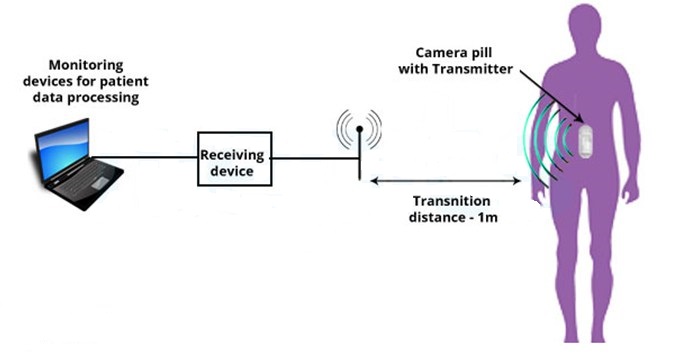
  • These pills contain sensors or tiny cameras that collect information as they travel through the gastrointestinal tract before being excreted from the body a day or two later.
  • These new electronic inventions transmit information such as acidity, pressure and temperature levels or images of the oesophagus and intestine to your doctor’s computer for analysis.
  • Doctors often use invasive methods such as catheters, endoscopic instruments or radioisotopes for collecting information about the digestive tract. So device companies have been developing easier, less intrusive ways, to gather information.
  • Digestive diseases and disorders can include symptoms such as acid reflux, bloating, heartburn, abdominal pain, constipation, difficulty swallowing or loss of appetite.”One of the main challenges is determining just what is happening in the stomach and intestines.” says Dr. Anish A. Sheth, Director of the Gastrointestinal Motility Program at Yale-New Haven Hospital.
  • Doctors can inspect the colon and peer into the stomach using endoscopic instruments. But some areas cannot be easily viewed, and finding out how muscles are working can be difficult.
  • Electronic pills are being used to measure muscle contraction, ease of passage and other factors to reveal information unavailable in the past.

  Digital Pen


digitalpen

  • A digital pen is one of the new electronic inventions that can help us record information.
  • Despite the digital age, we still use pens. But it would be great to have our handwritten notes and drawings digitally recorded without having to use a scanner.
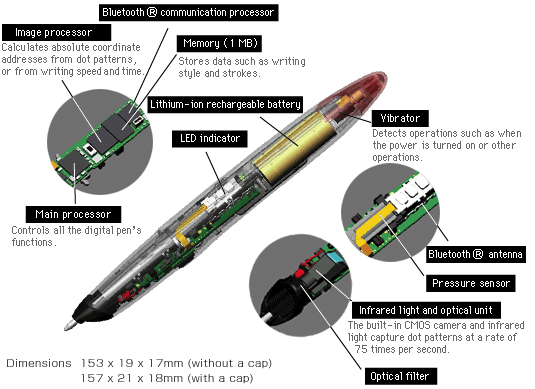
  • The Zpen from Dane-Elec is a wireless pen that uses a clip-on receiver to digitally record what you write.
  • It uploads the information to your computer where it can be viewed, edited and filed as a word processing document.
  • The digital pen utilizes character recognition software and works by recording movement. Features include profile creation, a dictionary and fifteen language options.

Treasury Merger by SBI

Treasury Merger by SBI

Dr. D. Nithya | Assistant Professor

Sankara Institute of Management Science(SIMS)

State-Bank-of-India

Five associate banks of SBI and Bharatiya Mahila Bank(BMB) were on 1st April merged with SBI.

The five associate banks are as follows:

  1. State Bank of Mysore
  2. State Bank of Hyderabad
  3. State Bank of Patiala
  4. State Bank of Bikaner and Jaipur
  5. State Bank of Travancore

The merger of the above banks was approved by Union government in the month of February 2017 and in March 2017 for BMB and it came into effect on 1st April 2017.

Back ground of the Merger

This initiative of merger stated in 2008. In 2008 the State Bank of Saurashtra merged with SBI and in 2010 State Bank of Indore merged with SBI. The State Bank of India has around 16500 branches which includes 191 foreign offices across 36 countries.

Key Lights of the Merger

By this merger State Bank of India will join the league of top five banks globally in terms of assets. As of now there is no Indian Bank featured in the list. This merger will pay way for more customer base with approximately 37 Crore with branch network of around 24000 and nearly 59000 ATMS across the country.  The deposit rate tends to increase including advances.  The bank will rationalize its branches by relocating some of the branches. This will lead the bank to optimize its operations and work on maximizing profitability.  Merger of the five associate banks with SBI will lead to cost saving and effective operational mechanism.


New accounting standards course to help read balance sheets better

New accounting standards course to help read balance sheets better

Dr.S.Sundararajan. Associate Professor, Sankara Institute of Management Science(SIMS)

       As the balance sheets of many of the Indian companies start changing in tune with Ind-As, the new accounting standards that Indian companies are transitioning to, it is critical to train those who write and read these reports. For instance, one of the important elements of the new accounting standards is around the re-evaluation of assets. It would only mean balance sheets will have to be read even more carefully now. For, better financials could well be an outcome of a one-time correction on account of asset re-evaluation rather than say a result of a more sustainable effort at improved operations.  In a bid to address some of these and other issues, the ICWAI-Management Accounting Research Foundation (ICWAI-MARF) in association with Hyderabad-based C&K Management has launched ‘The Accounting Standards for Practitioners (ASP)’. It is an e-learning course. Under this, accounting practitioners and students – CA, ICWAI, ACS, MBA, M Com, B Com, BBA – will undergo intensive 130 hours of online courses covering 36 standards. C&K Management, a ‘corporate training solutions’ entity is part of the Hyderabad-based TMI Group, which is one of India’s leading talent acquisition and management companies.

Last year, the ministry of corporate affairs had notified a road map for Ind-AS implementation in phases.  As per the plan, the first set of company with a net worth of over Rs 500Crores – listed and unlisted will start the implementation from April 1, 2016. The second phase, will start  from April 1, 2017 and will cover all listed companies and unlisted companies with a net worth of Rs 250 crore or more. In the third phase, NBFCs will be required to comply with Ind-AS in a phased manner, from accounting periods beginning on or after April 1, 2018 for the first phase and April 1, 2019 for the second phase.  “Students studying the courses – CA, ICWA, ACS, MBA, M.Com, B.Com, BBA – need the Ind-AS certification and will add a big value add to their resumes at the time of placement just like computer skills, accounting skills this Ind-AS course will fill this need,” said Chairman of TMI Group. The course, ‘Accounting Standards for Practitioners – ASP,’ has the total duration of over 130 hours, it provides an overview of each standard — it gives a quick snapshot of various concepts within the standard. It is priced at around Rs 6000. On the completion of the course, the participants can take the online test. The pro-metric test will be conducted at the ‘Aptech’ Test Centres, the exam partner. All participants who qualify the online pro-metric certification test shall be awarded with a certificate by ICWAI – MARF.

As we are one among the leading b-school, we can include this account practices in our autonomous curriculum with consultation of accounting experts and practitioners. This can create a very good employment opportunity in financial stream and develop emerging financial practitioners.